
Finding Marlin
How Pixar's Finding Nemo Course Corrects Our Helicopter Parenting Crisis

It’s difficult for me to process this, but I was 13 years old when Pixar’s Finding Nemo came to theaters all the way back in the much simpler year of 2003. When I walked into that movie theater, I was a pimply 13 year old teenage boy who did not consider himself too cool yet for Pixar movies (with good reason - we were living in the golden age of Pixar back then when everything they released was nearly flawless). That was 21 years ago, and I now write these words as a husband of almost 13 years and father of four whose beard is graying at an alarming rate. In 2003, I was basically Nemo. Now…I’m Marlin. Oh, how the time doth fly.
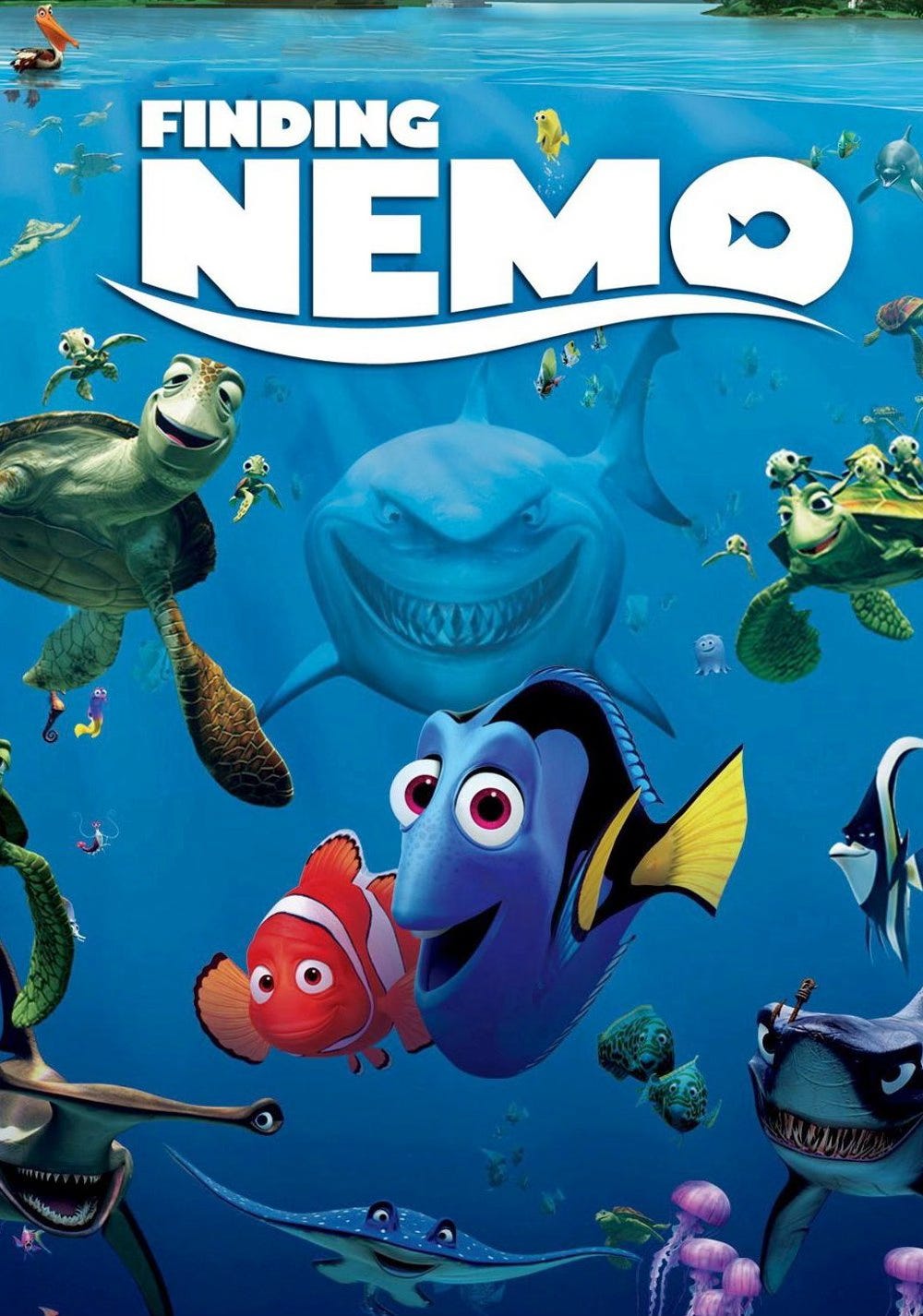
Yet despite the passage of time, this Pixar film is strikingly, almost eerily relevant to the parenting crisis of our day. The makers of the film had clearly put their finger on the toxic nature of helicopter parenting. We think of that as a modern term, but the research by Jonathan Haidt and his team in The Anxious Generation clearly demonstrates that the helicopter parenting phenomenon was being kindled to life in the 90s. In 2024, we’re suffering the societal consequences of almost 30 years of this overprotective, suppressive approach to raising our kids. And in 2003, Pixar provided us a compelling vision of a different way forward in this gem of a film.
First Day of School
The film opens by introducing us to Marlin and Coral, a happily married clownfish couple. The two have just purchased an anemone with a phenomenal ocean view (ha!) - an ocean view that they look forward to sharing with their one hundred plus unborn children (side note: the opening to the film is a moving testament to the value of life in the womb). Sadly, tragedy strikes when they are attacked by a predatory fish and Coral is killed, along with all of their unborn children.
All, that is, except for one. One precious egg with a precious life inside it.
Nemo.
Cue that beautiful, swelling soundtrack of hope by Thomas Newman. Seriously, pop on your music streaming service and listen to the main title track right now. It’s soul stirring.
The next scene takes place several years later. Nemo is physically unscathed from the tragedy, with the exception of one fin that is smaller than the other. Emotionally, he is bright, happy, and energetic - adorably enthusiastic about going to his first day of school. In this scene, we are introduced to an interesting dynamic: a tender, warm, joyful father-son relationship that swims above an undercurrent of overprotectiveness from Marlin. We find out that Marlin has held Nemo back from attending school for a number of years. He has an elaborate safety routine established for checking on danger before exiting their home. Nemo complains about a time Marlin panicked in public over a charging snail. Etc.
This is all revealed hilariously, anchored by the voice work of Albert Brooks (Marlin) and Alexander Gould (Nemo). But it’s clear that Marlin is what we would today call…a helicopter parent. He loves his son, and Nemo loves him. But Nemo is being suffocated by Marlin’s unwavering parental watch. In one sense, Marlin’s helicopter parenting is understandable given the tragedy that their family has gone through. Yet beneath the jokes and laughter shared between father and son, there is something profoundly unhealthy between these two: Nemo is embittered by his father’s coddling, and Marlin treats his son as though he is incompetent. Their relationship has an illusion of happiness, but there are cracks in the foundation.
These cracks are exposed for what they are in the “drop-off” scene. On that glorious first day of school, Nemo joins his classmates on a field trip, which Marlin reluctantly allows. That is, until he realizes that the students are headed to the drop-off - a location where the ocean bed drops off significantly into what the fish call “open water.” Marlin fumes at the school administrators who have recklessly allowed such a dangerous field trip and rushes to pick up his son.
Nemo, meanwhile, has made friends and is having the time of his life being…well…a kid. He and a few friends sneak off the beaten path unbeknownst to their teacher to see the drop-off for themselves. In the distance, they see something strange - the shadowy underbelly of an anchored butt (sorry, I meant boat).
Again, being kids, the friends play a game of swimming out into open water, daring each other to see how close they can get to the boat. Nemo, channeling the relentless caution of his father, hesitates to join them, and it’s just at that moment than Marlin bursts onto the scene to “rescue” his son. Thinking Nemo had just been about to swim into open water, Marlin is livid and shamefully berates his son in front of his new friends, insisting Nemo is not ready to handle school and that he must wait “another year or two.” Nemo angrily refuses to go back with his dad and the argument escalates to the point where Marlin shouts at him:
“You think you can do these things but you just can’t, Nemo!”
And Nemo responds with the words every parent fears: “I hate you.”
It’s a painful scene to watch. But it exposes the relationship between Marlin and Nemo for what it is: Marlin thinks he is protecting his son, but what he’s actually communicating to Nemo is that he is incompetent - unable to handle challenges or learn from mistakes. And Nemo resents his dad for it. Do they love each other? Of course. But if something doesn’t change, their father-son relationship is headed towards disaster.
Chasing Nemo, Finding Dory
Ironically, Marlin’s overprotectiveness becomes the catalyst for actual tragedy. With his dad preoccupied explaining to the teacher Nemo’s poor swimming ability due to his damaged fin, Nemo defiantly swims out to the distant boat to prove a point. He can swim just fine, thank you very much. Unfortunately, the divers from the boat appear at that exact moment, capturing Nemo and causing the fish of the reef to flee in a panic. Marlin chases desperately after the boat, but it’s hopeless.
In the midst of the chase, Marlin encounters none other than Dory, that lovable, blue, short-term-memory losing fish, voiced perfectly by Ellen Degeneres. Together, they set out to find Nemo, and Marlin’s transformation through risk and adventure has begun.
The developing friendship between Marlin and Dory is one of my favorite relationships in any animated film. Dory’s joyful, naive, innocent recklessness is the perfect complement to Marlin’s risk-averse curmudgeonliness. At first, Marlin is paired with Dory against his will, but the more time they spend together, the more she unintentionally helps him to see the joy that is to be found in adventure. From defeating a vicious deep sea fish to surviving the dangers of a jellyfish forest, Marlin begins to recognize the value of living life without the shackles of caution weighing down every moment. In other words, he begins to live the life that he’s denied to his son for years. And he recognizes its goodness.
Let Them Fly Solo, Dude
There are two moments on their journey that especially serve to open Marlin’s eyes to his overprotectiveness as a parent. The first is on the heels of their escape from the jellyfish forest. Marlin and Dory are rescued by a herd - or whatever you call it - of sea turtles, who exude a delightful California surfer vibe. These turtles are riding the East Australian Current with their little ones in tow, and they do so with a rather…chillaxed vibe. Which Marlin is, in spite of himself, somewhat impressed by.
At one point, a kid turtle is knocked outside of the current while playing a game, to Marlin’s horror. He rushes forward to try to save him, but Crush, the turtle’s father, stops him: “Let us see what Squirt does flying solo.”
Marlin and Crush watch on as Squirt finds his way, with no help, back into the current. He comes back to them in an abundance of excitement, exclaiming to his dad, “Did you see me?! Did you see what I did?!” Rather than giving his son a lecture for being too reckless and getting knocked out of the current, Crush celebrates the success of his son in getting back to the current on his own.
What Marlin is seeing is good parenting - a dad letting his son take risks, learn, and cheer him on when he finds success.
You Just Can’t, Nemo
The next moment I have in mind is essentially the climax of Marlin’s character growth. All he’s learned about being a good father comes to a head when he and Dory are nearly eaten - or so Marlins thinks - by an enormous whale. Stuck inside the water reserve of its mouth, Marlin’s hopes are crushed, fearing he will never see his son again. Things look all the more dire when the whale lifts its enormous tongue to send them to the back of its throat. Dory, fluent in whale, attempts to ask the whale what’s happening. As they hang in the air, Marlin snaps at Dory:
“You can’t speak, whale!”
“Yes, I can!”
“No, you can’t! You think you can do these things but you can’t, Nemo!”
Having just shouted at Dory one of the last words that he spoke to his son, a look of horrible realization comes across Marlin. But he doesn’t have much time to reflect as the whale tells Dory that it’s time to let go.
Of course, this moment is a metaphor for the entire lesson that Marlin has been learning throughout the movie: the power to let go. To let his son live life and to accept the risk that inevitably comes with living life.
Desperately, Marlin asks Dory how can she know? How can she know that something bad won’t happen?
Dory looks uncertain, and then answers honestly: “I don’t!”
I appreciate the wisdom of this moment - the acknowledgment that we don’t know if everything is, indeed, going to turn out okay. But despite this question, we are all faced with a choice - do we let go with an open hand (or fin), or do we relentlessly hold on?
Marlin pauses, weighing the decision.
And then…finally…he lets go.
The whale sends the two fish blasting through its wind pipe and landing them in Sydney harbor, exactly the place they’d spent the entire movie trying to reach.
Kids Weren’t Meant to Live In a Tank
While Marlin’s transformation in the film takes place facing the many dangers and adventures of the ocean (jellies and trenches and turtles, oh my), Nemo’s transformation happens, ironically, in a fish tank - literally a glass enclosure that’s about as perfect a metaphor for helicopter parenting as you can have. Within that fish tank, Nemo is surrounded by endearing yet naive pet store fish who have never been to the ocean. They happily welcome them to their isolated, artificial existence within the fish tank of a dentist’s office. But after the introductions, Nemo learns a horrible truth. He is going to be given to the dentist’s daughter - Darla, the fish killer.
Nemo panics, and in the process, he gets stuck within the filter tube. This is when he is introduced to Gill (Willem DeFoe) - the only fish in the tank who, like Nemo, hails from the big blue. The film’s introduction to Gill is important, as he serves as the antitype to Marlin - and the prophetic answer to the helicopter parenting crisis of our day.
While the other fish panic alongside Nemo, wanting to get him out, Gill insists that Nemo be left alone. He tells Nemo, “You got yourself in there, you can get yourself out.”
It seems harsh, but Gill doesn’t leave Nemo to figure it out for himself - he tells him what he needs to do in order to free himself from the tube. Nemo, regurgitating the view his father has drilled into him for years, insists, “I can’t! I have a bad fin!”
Gill, swimming to the side to expose a badly torn fin, replies, “It never stopped me.” Nemo is shocked to see another fish who shares his same “handicap,” and this moment is a turning point for him. Using Gill’s instructions, and after some difficulty, Nemo frees himself from the tube.
Having seen what Nemo can do, this leads Gill to an elaborate plan to escape the fish tank and get their entire crew back into the ocean where they belong. He later tells Nemo plainly - “Fish weren’t meant to live in a tank, kid. It does things to you.”
Human kids, of course, weren’t meant to live in a tank, either.
Taking Dominion and Bearing His Image
What Nemo learns in his time with Gill is competence. Contrary to the words of his father, he can do things. He is, in fact, capable of far more than he ever imagined. And what Marlin learns on his adventures with Dory is that his responsibility as a father is to not only protect his son, but also release him - to free him up to take risks, to learn, to fail, and to pick himself back up again, building confidence as he goes.
We get to see both lessons taken to heart towards the end of the film when Dory and an entire school of fish get caught up in a fishing net. Nemo knows exactly what to do in this situation, having been taught by Gill, and insists on stepping into the danger himself to lead everyone to safety. There’s a moment of hesitation, but Marlin has learned. He releases Nemo, and helps his son in leading all of the fish, Dory included, to safety.
This is largely what God has designed families, and specifically fathers, to do - to raise little image bearers to learn increasingly how to take dominion in the spheres of responsibility God will increasingly lay upon them. Dominion might seem like an extreme word, but it’s a Christian word that helps explain the calling God placed on us from the beginning:
Then God said, “Let us make man in our image, after our likeness. And let them have dominion over the fish of the sea and over the birds of the heavens and over the livestock and over all the earth and over every creeping thing that creeps on the earth.”
So God created man in his own image,
In the image of God he created him;
Male and female he created them.
And God blessed them. And God said to them, “Be fruitful and multiply and fill the earth and subdue it, and have dominion over the fish of the sea and over the birds of the heavens and over every living thing that moves on the earth.” - Gen. 1:27–28
God made us to bear his image - to represent him throughout the earth and in so doing to bring him glory. This is why we exist. And a significant part of our calling as image bearers is to rule - to have dominion, to bring God’s rule and order into chaos.
Our society thinks it’s the job of parents to protect our kids from all harm. We must, at all costs, keep our kids safe, right? But that’s not the job description that God has given to parents. He has assigned moms and dads (again, especially dads, and especially dads in relation to their sons) with the responsibility of teaching our kids how to bring dominion - to grow and develop skills of competence that enable them to bear God’s image in whatever spheres He might call them to.
This kind of child rearing requires both instruction and release - instilling wisdom in our kids while also allowing them the space needed in order to develop that wisdom themselves. We do not serve our kids by protecting them from every danger or doing their tasks for them. No one learns competence like that.
Love You, Dad
The last scene of Finding Nemo is a full circle return to Marlin and Nemo’s home. The film beautifully flips the opening - Marlin excitedly wakes his son up for school, races him to his field trip, and successfully tells the joke to the school administrators that he’d been stumbling over the entire movie. As Nemo’s class heads off for another field trip, Nemo tells Mr. Ray that he forgot something. He swims back to Marlin, unashamedly gives his dad a huge hug, and tells him simply, “Love you, dad.” Marlin responds in kind and then tells his son as Nemo swims away, “Now go have an adventure!”
This is a picture of the kind of parenting Christians need to pursue. So many kids are aching for this. So, parents, let’s love our kids enough to let them go. Let’s give them opportunities to learn from mistakes, to step into new situations, and discover that God has made them far more competent than they may have thought. Let’s protect, but not suppress as our children grow in their skills and abilities. Let’s teach them how to navigate risk rather than sealing them off from all danger. And let’s free them to take dominion and live their lives to the glory of God.